English or British? Four names, different meanings, and a history that shaped a nation.
Have you ever wondered why someone from Scotland might describe themselves as Scottish and British, but not English? Or why Great Britain and the United Kingdom are often used interchangeably, even though they do not mean the same thing? These distinctions may appear straightforward, yet they reveal a fascinating history of political unions, cultural identities and national differences.
To understand Britain, we must first distinguish between geography and politics. Great Britain is the largest island in the British Isles. It contains three countries: England, Scotland and Wales. Northern Ireland is not part of this island; it is situated on the separate island of Ireland.

The United Kingdom, officially the United Kingdom of Great Britain and Northern Ireland, is a sovereign state comprising four countries: England, Scotland, Wales and Northern Ireland. Unlike Great Britain, which is a geographical entity, the UK is a political and constitutional entity.
The expression British Isles refers geographically to the archipelago comprising Great Britain, the island of Ireland and numerous smaller islands, including the Hebrides, Orkney, Shetland and the Isle of Man. However, the term is politically sensitive in Ireland because of its historical associations. Some people prefer the expression Britain and Ireland.
The distinction is therefore essential: Great Britain is an island, the UK is a state, and the British Isles is a geographical term.
How did the United Kingdom develop? Four dates that changed history
The United Kingdom was not created in a single historical event. Its development involved several stages of political union, beginning with the relationship between England and Scotland.
In 1603, following the death of Elizabeth I, James VI of Scotland inherited the English throne and became James I of England. This event, known as the Union of the Crowns, brought England and Scotland under one monarch. Nevertheless, they remained separate kingdoms, each retaining its own parliament, legal system and institutions. Sharing a monarch did not mean sharing a state.
A more substantial transformation occurred in 1707, when the Acts of Union united England and Scotland to form the Kingdom of Great Britain. The two separate parliaments were replaced by a single Parliament at Westminster. Scotland, however, retained important national institutions, particularly its distinct legal system and Presbyterian church tradition. Political union did not eliminate institutional differences.
In 1801, another major change took place. Great Britain and Ireland were united to form the United Kingdom of Great Britain and Ireland. This arrangement abolished the separate Irish Parliament and brought Ireland into the political union. However, Irish nationalism and demands for self-government continued to challenge the relationship between Ireland and Britain.
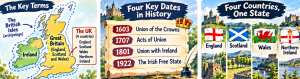
Finally, 1922 marked a decisive turning point. Following the Anglo-Irish Treaty, the Irish Free State was established, and most of Ireland left the United Kingdom. Northern Ireland, comprising six counties, remained within the union. The political structure subsequently evolved into the present-day United Kingdom of Great Britain and Northern Ireland.
These four dates illustrate how the present UK emerged through dynastic succession, parliamentary legislation and political transformation.